What Are the Top Hydrophobic Natural Fibers in 2026?
In 2026, interest in Hydrophobic Natural Fibers is growing as designers seek materials that manage moisture without relying only on synthetic coatings. Yet “water-repellent” can mean different things. A fiber may resist wetting briefly, absorb water slowly, or perform differently after washing. Those distinctions matter in a rain shell, a shoe lining, and a piece of home upholstery.
Textile researcher Dr. Subhash Anand’s work offers a useful materials-science perspective. An editorial paraphrase, not a verified verbatim quotation, is: “Fiber performance depends on structure, processing, and intended use.” That principle helps frame this guide. Kapok has a naturally waxy surface and hollow structure. Wool can resist liquid water at its surface while still absorbing moisture vapor. Coir’s coarse, lignin-rich structure suits certain durable applications, though it is not a universal substitute for treated technical fabrics.
Real-world details count. A drop beading on a fiber sample does not prove that a finished garment will stay dry. Spinning, weaving, finishing, abrasion, and laundering can all change performance. And natural does not automatically mean low-impact; sourcing and processing deserve scrutiny too. Some comparisons remain imperfect, because test methods and product claims do not always align. That deserves a closer look.
This overview compares the leading natural options by water response, practical uses, limitations, and care needs. It aims to separate inherent fiber behavior from added finishes, so readers can make more informed material choices.
What Hydrophobicity Means in Natural Fibers
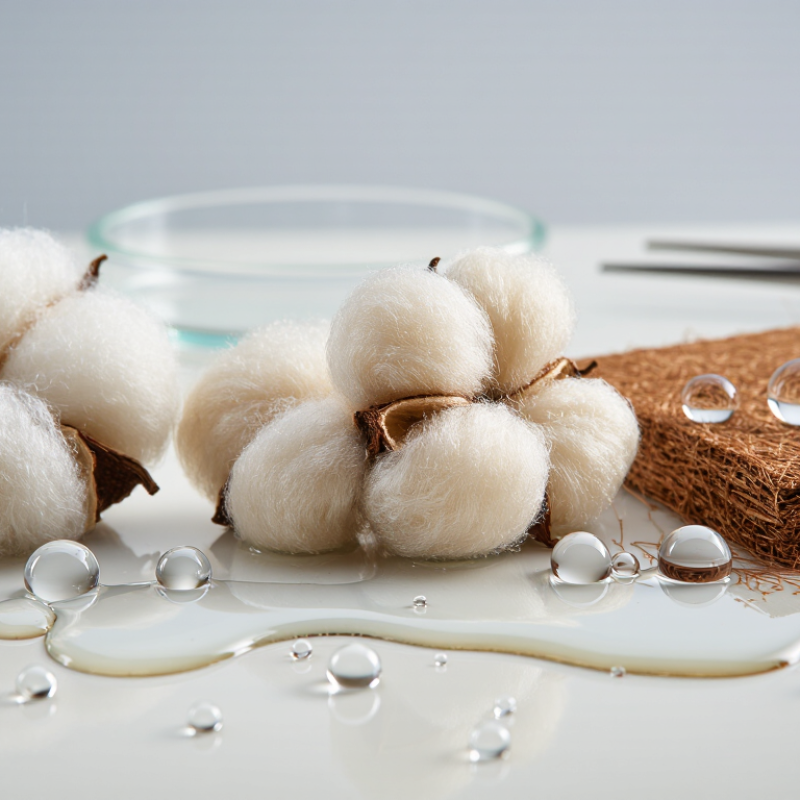
Hydrophobicity describes how strongly a surface resists wetting by liquid water. It does not mean a fiber cannot absorb moisture at all. A water droplet may bead on a fiber’s surface while water vapor still moves into its structure. That distinction matters.
Natural fibers vary in surface chemistry and internal structure. Wool can resist quick wetting because its scaly outer layer and naturally occurring surface oils slow liquid penetration. Yet wool can absorb water vapor, so calling it simply “waterproof” would be misleading. Cotton and flax, by contrast, contain cellulose that readily attracts water. They often soak up droplets and spread moisture through yarns. Silk sits somewhere between these familiar examples, with behavior shaped by its finish and fabric construction.
Testing conditions matter. A clean, tightly woven fabric may shed a brief splash, while the same fiber in a loose, worn cloth may wick water quickly. Fiber type alone cannot predict performance. Treatments, spinning, weave, and repeated washing all change the result. Even a water-beading test has limits: it shows surface behavior, not how a garment handles hours of damp weather. I may be simplifying a complicated subject, but hydrophobicity is best treated as a measurable tendency, not a permanent label.
How Natural Fibers Repel Water and Resist Moisture
What Are the Top Hydrophobic Natural Fibers in 2026?
How Natural Fibers Repel Water and Resist Moisture
Kapok, coir, and wool can resist liquid water, but none is truly waterproof. Kapok’s waxy surface and hollow structure help droplets bead and drain. Coir’s lignin-rich composition supports durability in damp conditions. FAO technical guidance reports coir can contain about 45% lignin, though the amount varies with fiber maturity. These qualities make surface structure and processing just as important as fiber name.
Wool shows why water repellency and moisture absorption are different. Its outer surface slows liquid wetting, while the fiber can take up water vapor. The International Wool Textile Organisation reports that wool can absorb up to 30% of its weight in moisture without feeling wet. That is useful in humid conditions, but it does not mean wool stays dry after prolonged soaking. It is an easy distinction to overlook.
Tips: Test a small swatch with droplets, then check how quickly it dries. Avoid assuming a “natural” finish will remain effective after washing; treatments and fabric construction matter. Even the best fiber has limits.
What Are the Top Hydrophobic Natural Fibers in 2026? — How Natural Fibers Repel Water and Resist Moisture
How to read the table: “Water repellency” describes how readily liquid droplets wet a fiber, while moisture regain describes moisture held from the surrounding air. These are different properties, so a fiber such as wool can shed brief splashes yet still absorb considerable atmospheric moisture. Values are typical approximate ranges for untreated fibers; published figures vary with test conditions, preparation, and fiber source. None of these fibers is inherently waterproof.
Which Natural Fibers Are Most Hydrophobic in 2026?
Among natural fibers, kapok is often one of the most water-repellent in its untreated state. Its waxy surface and hollow structure help it resist wetting, while keeping the fiber light. A drop may bead briefly rather than spreading at once. That distinction matters. Kapok can still take up moisture, and its behavior changes with cleaning, spinning, and fabric construction.
Coir, the coarse fiber from coconut husks, also resists water relatively well. Its stiff, lignin-rich structure makes it useful in items exposed to damp conditions, though it is not waterproof. Wool can shed light rain when its natural grease remains, but washing removes much of that protection. Not perfectly. The fiber can absorb moisture even while its surface delays wetting. “Hydrophobic” therefore describes a tendency, not a guarantee.
For a fair comparison, examine untreated fibers and finished fabrics separately. Place equal-sized water drops on each sample and note how quickly they spread or soak in; repeat the test, since one result can mislead. Kapok and coir are strong candidates for natural water resistance, while greasy wool may perform well under specific conditions. There is no single winner for every textile. The weave, surface wear, and processing can change what a person sees in practice.
What Are the Top Hydrophobic Natural Fibers in 2026?
Typical moisture regain (%) under standard textile conditioning. Lower values indicate less moisture absorbed from humid air.
Kapok, cotton, and ramie show relatively low typical moisture regain among these fibers. Moisture regain is a practical comparison, not a direct measure of water repellency; values vary with fiber grade and test conditions.
How Kapok, Wool, and Coir Differ in Water Resistance
Kapok, wool, and coir resist water in different ways. Kapok’s waxy surface helps shed droplets, while its hollow fibers make it exceptionally light. Wool also resists brief splashes, but it readily takes up moisture vapor. ASTM D1909’s commercial moisture-regain table lists wool at 16%, compared with 10% for kapok and coconut fiber. These figures describe moisture under standard conditioning, not liquid-water absorption. That distinction matters.
Wool’s surface can feel dry while moisture moves into the fiber. It suits changing humidity, but a soaked wool filling dries slowly. Kapok is less comfortable with prolonged wetting: compressed or poorly ventilated filling may hold dampness between fibers. Coir behaves differently. FAO coconut-fiber references report lignin content around 40–45%, a feature associated with durability and resistance to decay. Coir can handle damp settings, yet it is not waterproof; water may remain in a dense mat.
For a cushion exposed to quick spills, kapok may shed drops best. For moisture-buffering comfort, wool offers a different advantage. Coir is useful where firm support and damp-condition durability matter more than softness. None is a magic dry material. Fiber form, weave, density, and drying airflow can change the result, and standard regain values cannot predict every real-world spill.
How to Compare and Choose Hydrophobic Natural Fibers
“Hydrophobic” does not mean waterproof. Wool can shed brief splashes because its scaly surface and natural oils slow wetting, yet the fiber can still absorb moisture. Kapok has a waxy surface and low moisture uptake, but its short, slippery fibers can be difficult to spin into durable fabrics. These differences matter more than a simple ranking.
Compare fibers under the conditions your product will face. Place equal-sized samples under a small, measured splash, then note how quickly droplets spread and how long the fabric takes to dry. Check moisture regain, too: a surface may resist liquid while still absorbing humidity. Feel the fabric after drying. Stiffness, odor, and lingering dampness are practical clues.
Choose wool for garments that need warmth and some splash resistance; consider kapok for lightweight filling where compression is limited. Check fiber composition and whether water-repellent performance comes from added treatment, since finishes may wear off. I used to treat “natural” as a reliable performance signal. It isn’t. Fiber quality, yarn structure, and weave can change results, and a tightly woven linen cloth may shed water better than a loosely knitted wool fabric. Test the finished material, not just the fiber name.