
Choosing Polypropylene Microfibers for concrete is not simply a matter of buying the shortest or cheapest fibers. The right choice depends on the mix, placement method, and cracking risk. Polypropylene Microfibers are commonly used to help control early plastic-shrinkage cracking; they do not replace structural reinforcement. That distinction matters.
Dr. Nemkumar Banthia, a researcher in fiber-reinforced concrete, has published extensively on fiber performance. A concise paraphrase of a practical lesson from his work is: “Match the fiber to the crack-control need, then verify it in the mix.” Treat that as a summary, not a verbatim quotation. In practice, compare fiber length, diameter, aspect ratio, dosage, and dispersion guidance. Picture a wet mix moving through a pump hose or spreading beneath a trowel: fibers must disperse without creating clumps or making placement difficult. Check the product’s technical data and test the intended dosage in a representative trial batch. Small details count.
There is no single best microfiber for every slab. Exposure, finishing demands, and batching equipment can change the choice. Even a technically sound product may disappoint when it is poorly dispersed. That part is easy to overlook. This guide explains which specifications to compare, what questions to ask suppliers, and how to assess trial results. It also points out a limitation: published product values do not guarantee identical field performance. Careful selection helps, but observation on site still matters.
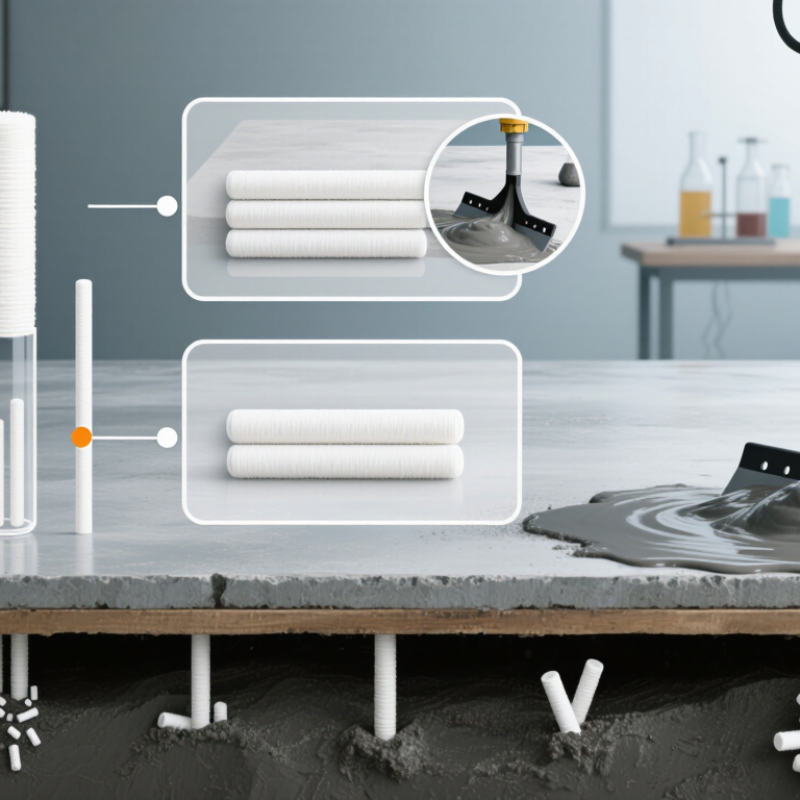
Start with the concrete’s actual job, not the fiber label. A warehouse floor, a thin repair overlay, and sprayed lining face different demands. Record member thickness, placement method, finishing schedule, and expected loading. Will crews pump the mix through a narrow hose, or place it from a truck chute? That detail matters. Microfibers can help limit plastic-shrinkage cracking while concrete is fresh. They do not automatically replace reinforcing bars or structural fibers. Be precise about the goal.
Translate that goal into measurable requirements: crack control, impact resistance, abrasion performance, or reduced surface defect risk. Specify when the property matters and how it will be checked, through project specifications, trial batches, or relevant test methods. Do not choose dosage by habit alone. Fiber length, diameter, and dosage can affect dispersion, slump, pumping, and finish. Too much fiber may make placement harder; too little may miss the intended effect. Run a representative trial with the same cement, aggregates, admixtures, and equipment. Inspect for clumps, exposed fibers, and finishing drag. Real sites are messier. A trial may not reproduce every weather or crew condition, so leave room for adjustment.
Define the application and performance requirement first. These representative dosage ranges are starting points, not universal specifications; confirm the fiber supplier’s guidance and validate the mix with trials.
Plastic-shrinkage control generally uses lower dosages, while fire-spalling mitigation may require higher dosages. Microfibers help control early cracking and do not replace structural reinforcement.
Polypropylene microfibers for concrete are commonly supplied as fine monofilaments or fibrillated bundles. Monofilaments spread through the mix as individual strands and can help limit early plastic-shrinkage cracking. Fibrillated fibers have a net-like shape that opens during mixing, offering more contact within the cement paste. Neither type replaces reinforcing bars or structural design. Small differences matter.
Compare fiber length, diameter, and aspect ratio, not just the product name. Longer fibers may bridge wider gaps, but can be harder to disperse in a stiff mix. Fine fibers provide many strands per unit of weight, yet poor mixing can leave visible clumps. Check tensile strength, elastic modulus, and chemical resistance in the technical data. Polypropylene resists the alkaline concrete environment, but its relatively low stiffness means it is not a substitute for steel reinforcement. Results also depend on the mix and placement.
Tips: Match fiber dimensions to the intended use, then trial a small batch with your actual aggregate and mixer. Watch for clumping, reduced workability, and fibers collecting near corners. Follow the specified dosage and mixing sequence; adding extra fiber is not automatically better. I have found that a tidy laboratory mix can behave differently on site, so record the water content and mixing time during trials.
How to Choose Polypropylene Microfibers for Concrete?
Choose a Suitable Dosage and Confirm Mixing Compatibility
Choose dosage from the fiber supplier’s technical data, then check it against the concrete mix and project requirements. There is no universal rate: fiber length, cement content, aggregate size, and the intended crack-control role all matter. Microfibers can help limit plastic-shrinkage cracking, but they do not replace structural reinforcement. Small trials matter.
For a practical check, batch a measured quantity and record the dosage per cubic metre. Watch the mix as fibers enter: slow, even feeding helps reduce clumps, especially in a stiff mix. Follow the product’s mixing instructions, since the recommended addition point and mixing time can vary. Check slump, air content, and finishability after mixing; extra fibers may make placement harder without improving the result.
Compatibility deserves a site trial, not just a datasheet review. Add the fibers to the actual mixer with the planned aggregates and admixtures, then inspect a fresh sample for visible balls or uneven distribution. Check whether workers can place and finish the concrete as expected. A smooth surface alone is not proof of uniform fiber dispersion, so note the batch procedure and compare trial results with the project’s acceptance criteria. One thing is easy to miss: changing the water content to restore slump can alter the mix’s performance.
How to Choose Polypropylene Microfibers for Concrete?
Check the product data sheet for fiber length, diameter, shape, and recommended dosage. Confirm that the material meets a relevant specification, such as ASTM C1116/C1116M, and check the applicable edition. A standards reference is useful, but it does not prove performance in your mix. Ask for test reports that identify the method, dosage, concrete mix, curing conditions, and results. For plastic-shrinkage cracking claims, look for testing suited to that purpose, such as ASTM C1579. Compare like with like.
Tips: Make a small trial batch using your actual cement, aggregates, and mixing sequence. Watch for fiber clumps, reduced workability, and changes in slump or air content. Then assess the concrete under conditions close to the job site. Microfibers can help limit plastic-shrinkage cracking, but they do not prevent every crack or replace structural reinforcement. The result also depends on placement, curing, and jointing. A lab result may not transfer neatly to the field; that uncertainty deserves attention.
| Selection dimension | Useful data or benchmark | What to verify | What it means for concrete performance |
|---|---|---|---|
| Applicable product standard | ASTM C1116/C1116M covers fiber-reinforced concrete and includes synthetic fiber-reinforced concrete as Type III. EN 14889-2 covers polymer fibers for concrete. | Request a declaration of conformity identifying the standard and edition, fiber type, intended use, and declared properties. Confirm the project specification accepts that standard. | A standard declaration establishes a basis for product identification and evaluation; it does not by itself guarantee a particular crack reduction or concrete strength. |
| Microfiber classification | Under EN 14889-2 terminology, polymer fibers are generally classified as microfibers when their diameter is below 0.30 mm; fibers at or above 0.30 mm are generally classed as macrofibers. | Check the declared diameter and whether the fiber is monofilament or fibrillated. Confirm the classification against the edition specified for the project. | Microfibers are commonly selected to help control early-age plastic shrinkage cracking. They should not automatically be treated as structural reinforcement. |
| Fiber length and geometry | Commercial microfibers are available in a range of lengths, often around 6–19 mm. This is a market range, not a universal standard requirement. | Obtain the product’s declared length, diameter or equivalent diameter, and any relevant aspect-ratio data. Check that the geometry suits the aggregate size and placement method. | Length and geometry affect dispersion, handling, finishability, and the fiber’s ability to distribute through the mix. Confirm performance in a representative trial batch. |
| Polypropylene density | Polypropylene typically has a density of approximately 0.90–0.92 g/cm³. | Compare the declared value with the technical data sheet and use the stated value when calculating fiber volume or checking batch quantities. | Because polypropylene is less dense than water, fibers can be prone to floating or uneven distribution if mixing and placement are not controlled. |
| Dosage | A commonly trialled dosage range for concrete microfibers is about 0.6–0.9 kg/m³ (approximately 1.0–1.5 lb/yd³). The appropriate dosage depends on the product and application. | Use the product-specific recommended dosage and the project specification. Record the actual batch quantity and verify consistent dispersion; do not substitute dosage recommendations between products. | Dosage can affect crack-control results, workability, and finishing. Determine the target through trial mixes and the relevant performance test rather than assuming that more fiber always gives better results. |
| Plastic shrinkage crack testing | ASTM C1579 provides a method for comparing plastic shrinkage cracking in restrained concrete slabs, including comparisons of fiber-reinforced and reference mixtures. | Request the full report, including mixture proportions, fiber dosage, test conditions, control mixture, crack measurements, and number of specimens. | Use comparative results to judge performance under the test conditions. Laboratory results are not a guarantee of field performance, which also depends on weather, curing, and construction practices. |
| Flexural performance | ASTM C1609/C1609M measures the flexural performance of fiber-reinforced concrete using a beam test and reports load-deflection response and residual strengths. | If post-crack capacity matters, request results for the proposed mix and dosage, including residual-strength values and the complete test report. | Do not infer structural residual capacity from a microfiber label or plastic-shrinkage test. Structural design credit requires applicable test data and approval by the project design professional. |
| Fresh-concrete workability and finishing | There is no single universal workability change that applies to every microfiber and mixture. Effects depend on fiber geometry, dosage, aggregate grading, and admixtures. | Run a trial mix using the intended materials and mixing sequence. Record slump or other specified workability measures, finishability, visible fiber balls, and surface appearance. | Good dispersion and a suitable mixture help limit clumping and finishing problems. Do not add water solely to restore workability without following the mix design and project requirements. |
| Mixing and dispersion | Follow the fiber supplier’s written batching instructions and the concrete producer’s approved mixing procedure. | Confirm addition order, mixing time, packaging or feeding method, and any limits for the batch plant or mixer. Inspect trial and production batches for uniform distribution. | Consistent dispersion is important for repeatable performance. Poor addition or inadequate mixing can cause clumping and uneven fiber distribution. |
| Temperature properties | Polypropylene commonly melts in the approximate range of 160–170°C; the exact value depends on the polymer grade and test method. | Request the declared thermal data when temperature exposure is relevant. Do not use melting point alone as evidence of fire resistance or structural performance at elevated temperatures. | Thermal behavior is a separate consideration from early-age crack control. Specify and assess fire or high-temperature performance using project-relevant evidence. |
| Quality control and traceability | Product data should identify the fiber and provide declared properties, recommended dosage, handling instructions, and relevant test documentation. | Check lot identification, certificate or test-report dates, property tolerances, and whether the submitted data correspond to the product being delivered. | Traceable, product-specific documentation helps confirm that delivered material matches the material evaluated in the mix trial or project submittal. |
Note: Values described as typical or commonly used are general selection references, not universal acceptance limits. Confirm requirements against the project specification, the applicable edition of each standard, product-specific documentation, and trial-mix results.
A supplier’s brochure is only a starting point. The Global Cement and Concrete Association estimates that about 14 billion m³ of concrete is used worldwide each year, making consistent material verification important. Ask for a lot-specific certificate of analysis covering fiber length, diameter, tensile strength, and moisture content. Confirm that the reported values match the product delivered, not just a general specification sheet. Paper is not performance.
For microfibers intended to limit plastic-shrinkage cracking, request test results that state the mix design, fiber dosage, and test conditions. ASTM C1579 measures plastic-shrinkage cracking under controlled conditions; results from a different mix may not predict your site’s outcome. ASTM C1116/C1116M also provides specifications for fiber-reinforced concrete. Check that the supplier’s documentation identifies the fiber type and intended application. I would not treat one laboratory result as a guarantee; mixing equipment and jobsite handling can change fiber dispersion.
Tips: Order a small trial quantity. Compare a control mix with a fiber mix, then inspect fresh concrete for visible clumps and review the cracking results. Ask the supplier how they control batch consistency and handle complaints. A clear answer matters.